Steampunk Spotter
Meet Rulus: The Spotter Crew's Compliance Inspector
June 17, 2026 - Words by The Spotter Team - 4 min read

Every crew needs someone who never bends the rules. On the Spotter Crew, that someone is Rulus — and he wouldn’t have it any other way.
Who is Rulus?
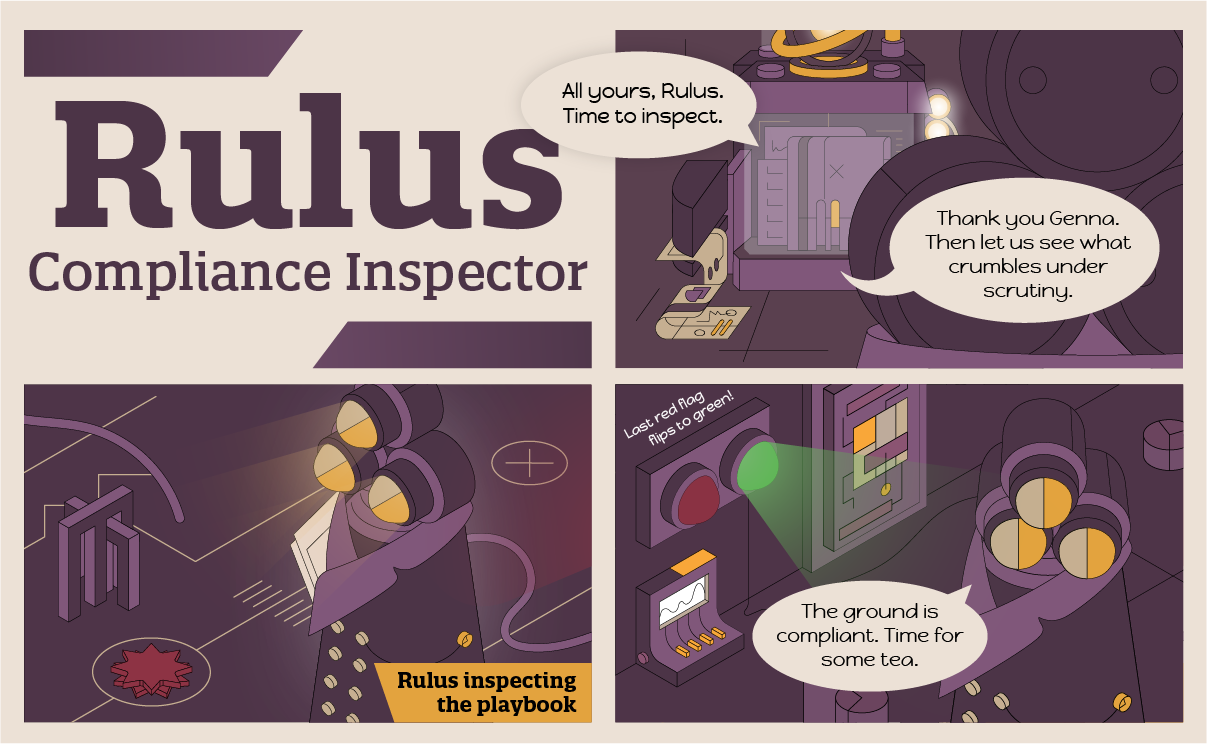
Rulus is the Spotter Crew’s Compliance Inspector. Tall, cloaked, and unmistakably commanding, he moves through the central monitoring chamber with the unhurried certainty of someone who knows exactly what the rules are — and exactly who’s breaking them.
His most distinctive feature is his head: three large cylindrical lenses arranged in a triangular formation, each glowing with a warm, watchful light. They don’t miss a thing. While the rest of the crew might pause for banter or the occasional coffee break, Rulus is already three playbooks ahead, scanning for anything out of line.
He’s not cold — just precise. There’s a quiet satisfaction in the way he works, a sense that for Rulus, a clean compliance report is the celebration. And though he’d never say it out loud, he genuinely likes his crewmates. (Don’t tell him we told you.)
“I don’t write the rules. I am the rules.” — Rulus
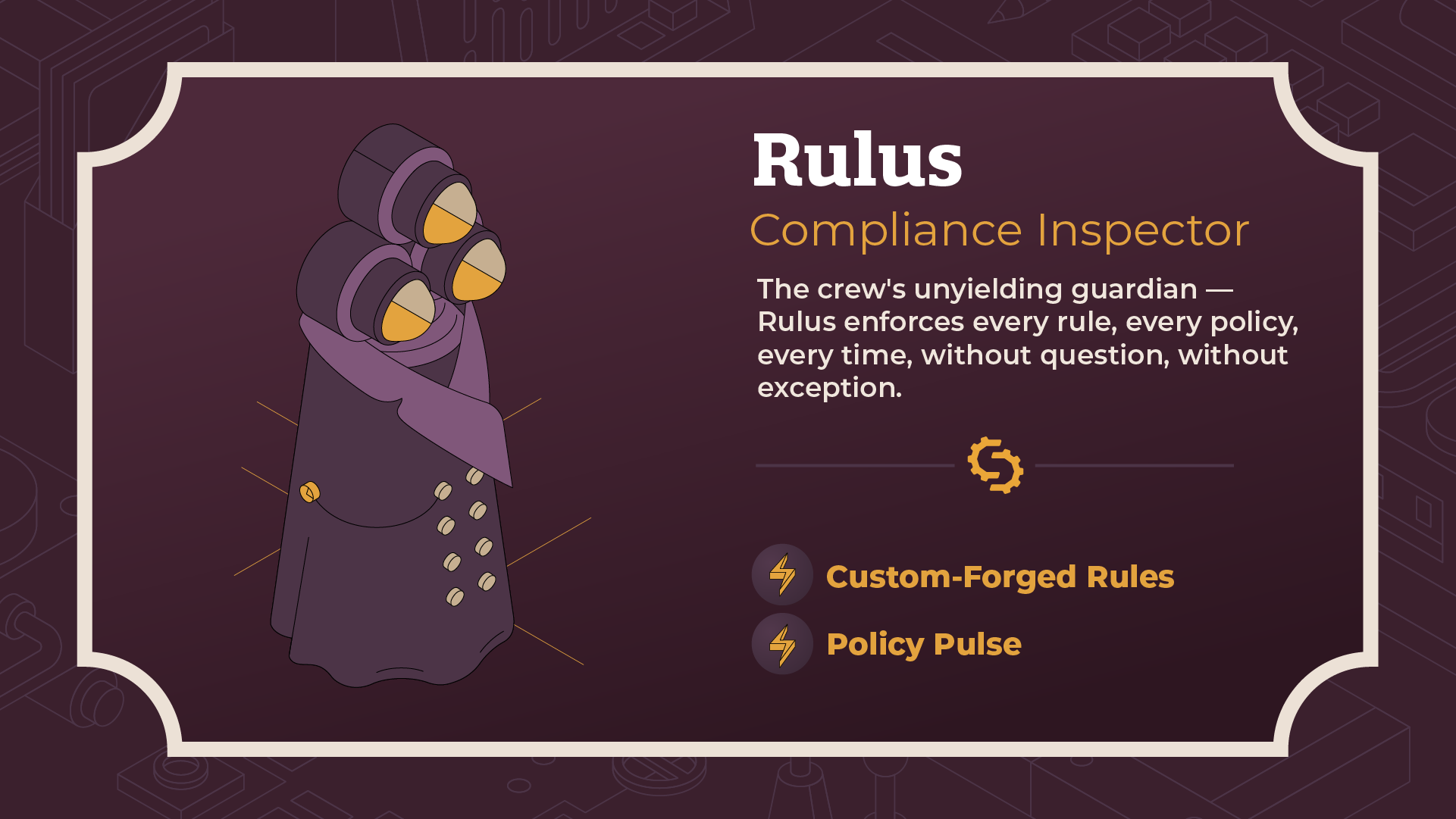
What Rulus Does: Custom Policies in Steampunk Spotter”
Rulus represents one of Steampunk Spotter’s most powerful capabilities — Custom Policies.
Here’s the distinction that matters: Spotter ships with a comprehensive library of built-in checks. These are rules and best practices that the XLAB Steampunk team has built, tested, and validated — covering deprecated modules, security misconfigurations, upgrade compatibility, and more. Think of them as the standing regulations of the automation world.
Custom Policies are different. These are the rules you write — your organization’s specific requirements, your team’s standards, your compliance mandates. Rulus is the one who carries them into every scan.
Maybe your organization requires that all playbooks use fully qualified collection names. Maybe no task can run with become: yes without an accompanying comment. Maybe there are naming conventions, tag requirements, or environment-specific constraints that no generic tool would ever know about. Rulus doesn’t just enforce what Steampunk Spotter knows — he enforces what you decide matters.
And he does it without exception.
Why Custom Policies Matter
Picture a team of five engineers reviewing each other’s playbooks before anything ships. Someone mentions that all tasks should use fully qualified collection names. Everyone nods. It’s understood.
Six months later, the team is fifteen people. Then thirty. There are sub-teams now, different time zones, three separate projects running in parallel. That conversation? It’s buried in some thread nobody can find anymore. The engineer who joined last month never saw it. The one who did see it interpreted it differently. And the playbook that just passed every lint check still quietly violates four internal standards that exist somewhere in a shared wiki — a wiki that hasn’t been opened since the last sprint planning.
This is how standards drift. Not through negligence. Not because anyone stopped caring. Just because informal agreements don’t scale, and documentation alone was never enforcement.
Rulus doesn’t care how the agreement was made or where it was written down. He only cares whether the playbook in front of him follows it. When a playbook goes through Spotter, it doesn’t just get checked against the standard rulebook — it gets checked against your rulebook. The one your team actually lives by. Every scan. No exceptions, and certainly no excuses.
That’s policy-as-code in the most practical sense: your standards stop being something engineers try to remember and start being something the tool simply enforces — automatically, consistently, every single time.
What Rulus Looks Like in Practice
When a playbook enters the scanning chamber, Rulus activates all four of his operational modes:
- Policy Pulse — applies your custom policies across the system, checking every task, variable, and module against your defined rules.
- Compliance Check — cross-references playbook actions against your organization’s accepted patterns and flags anything that steps out of line.
- Boundary Builder — makes your policy boundaries visible, showing the safe operating parameters so engineers know exactly where the lines are before they run.
- Rule Engine — the foundation of it all: the mechanism by which you define, version, and update your policies so they stay current as your standards evolve.
The result is a scanning process that doesn’t just catch generic Ansible mistakes — it catches your organization’s specific violations, before they reach production.
The Rest of the Crew Respects the Rulus
Nobody on the Spotter Crew argues with Rulus. Not because he’s intimidating (though he is), but because everyone understands that the rules he enforces exist for a reason. Fewer surprises. Cleaner playbooks. Automation you can actually trust at scale.
His presence in the monitoring chamber is a constant reminder: compliance isn’t a one-time checklist. It’s an ongoing condition — and it requires someone whose job is to make sure it never slips.
“Security isn’t a feature — it’s the foundation.” — Rulus
Start Enforcing Your Standards
Every organization has standards. The hard part is making sure they’re actually enforced — consistently, automatically, across every playbook your team touches. Steampunk Spotter’s Custom Policies feature is how you get there.
Reserve a free script assessment and we’ll show you exactly how Custom Policies can encode your organization’s compliance rules and put Rulus to work on your Ansible Playbooks.