We tested Claude Opus 5.5 and GPT-6 Astra on Ansible: read the findings
November 27, 2026 - Words by Luka Boljević - 5 min read
We gave Claude Opus 5.5 and GPT-6 Astra the same real Ansible task, with one run per model, and checked every AI-generated playbook with Steampunk Spotter, our governance layer for Ansible and Terraform code. Both models wrote complete playbooks for a 10-switch Cisco rollout, and neither made the FQCN mistakes that were common in earlier models. Spotter flagged issues in both, and a closer look shows why reading the findings matters more than counting them.
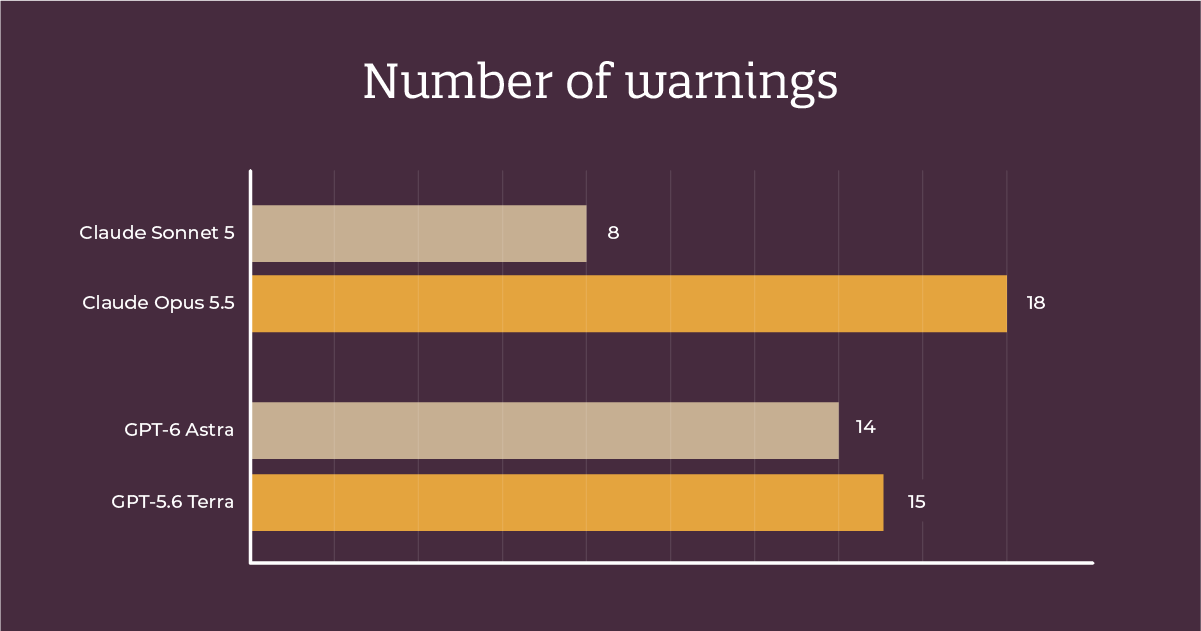
Claude Opus 5.5 had two errors, both placeholder passwords in a separate vault file. That’s a sensible pattern, but it can still turn into a real leak. Both models also left warnings that matter, 18 for Opus 5.5 and 14 for GPT-6 Astra, mostly about module defaults that changed between versions.
The task comes from our Q3 AI Model Leaderboard where we tested AI models on three Ansible scenarios. We also tested GPT-6.1 Sol, Claude Sonnet 5.5 and DeepSeek V4.1 Flash on the same task, and you can read those results in our companion post.
How we ran the test
The prompt describes a network change that many teams automate: 10 Cisco Catalyst switches across two sites, all on IOS-XE, managed with the cisco.ios collection. Each model had to produce playbooks that do three things in this order:
- Install the latest approved IOS-XE image on each switch.
- Configure the access ports each switch role needs (core or access).
- Reboot the switches in a controlled order and confirm each one comes back online before moving to the next.
To give the new models something to measure against, we ran the same prompt on the three models from our Q3 leaderboard: Claude Sonnet 5, GPT-5.6 Terra and DeepSeek V4 Flash. Every model got one attempt. Spotter then checked each output against its default rule set.
This setup is generous to the models. Nothing ran on real hardware, and Spotter checked the code only against its built-in rules, without any of the company-specific policies a real team would add.
TL;DR: the results
| Model | Generation | Errors | Warnings | Hints |
|---|---|---|---|---|
| Claude Opus 5.5 | New | 2 | 18 | 34 |
| GPT-6 Astra | New | 0 | 14 | 40 |
| Claude Sonnet 5 | Previous | 6 | 8 | 69 |
| GPT-5.6 Terra | Previous | 0 | 15 | 28 |
| DeepSeek V4 Flash | Previous | 4 | 11 | 31 |
Compared with the previous models
Claude improved on errors but performed worse on warnings. Opus 5.5 had 2 errors, compared to 6 for Claude Sonnet 5, the previous Claude model in our test. GPT-6 Astra matched GPT-5.6 Terra with zero errors. Warnings went the other way for Claude, rising from 8 to 18, while OpenAI’s stayed level at 14 compared to 15.
Short module names were no longer an issue. E903, which flags a short module name where a fully qualified collection name (FQCN) is expected, was the error we saw most often in the Q3 leaderboard. Opus 5.5 and GPT-6 Astra used fully qualified names throughout. Claude Sonnet 5 and DeepSeek V4 Flash still slipped, with 3 and 4 cases.
Model by model
Claude Opus 5.5: careful with secrets, but the most changed defaults. Spotter flagged two E3302 errors for hardcoded secrets. Both were CHANGE_ME placeholders in a separate vault.yml file, with a comment telling the engineer to replace and encrypt them.
Opus 5.5 also had 18 warnings, and 15 of them were W1800, the highest count we recorded in this round of tests. W1800 means the playbook relies on a module default that changed between collection versions, so on a switch rollout a reboot or port setting could behave differently than the engineer expected. A model can’t know which defaults changed after its training data was collected, while Spotter checks each parameter against the collection version you actually use. Opus 5.5 also used ignore_errors once.
GPT-6 Astra: 14 warnings to review. Twelve of them were W1800, the same changed-default issue we saw in Opus 5.5, and two were external Python imports. It didn’t use ignore_errors.
What this means when you pick a model
GPT-6 Astra had no errors, but its 12 changed-default warnings still need a review before the playbook runs. Claude Opus 5.5 handled secrets more carefully than Claude Sonnet 5, but it left the most changed-default warnings. On this task, Claude Sonnet 5.5 did better than Opus 5.5, with zero errors and 15 warnings, as we cover here.
The bigger lesson is that a count of findings is where a review starts. Two errors can be a reasonable pattern with a real risk attached. Spotter reports each finding with the file, the line, the rule and a link to its documentation, so engineers can quickly decide what to fix.
The same applies to your own standards. Rules like which collections are approved or how secrets must be stored are specific to your organization, so no model can learn them from public code. Spotter enforces them as policy on AI-generated code and on code your engineers write, in the IDE, in CI/CD, and inside AI assistants through Spotter MCP.
Wrap up
Claude Opus 5.5 and GPT-6 Astra both wrote complete playbooks for a 10-switch rollout, and neither made the FQCN mistakes we saw in earlier models. Their error counts need a closer look, though: Opus 5.5’s were placeholder secrets that could still turn into a leak. Both still left warnings that could change how production switches behave, which is why AI-generated Ansible should go through a deterministic policy check before it runs.
If you’d like to see how Spotter checks AI-generated Ansible and Terraform code in your own workflow, book a demo and we’ll walk through it with your setup.
Frequently Asked Questions
Is Claude Opus 5.5 good for writing Ansible playbooks?
In our test, Claude Opus 5.5 wrote a complete playbook for a 10-switch Cisco rollout with only two errors, both placeholder passwords in a separate vault file. It did leave 18 warnings, more changed-default warnings than any other model we tested. Its output is a solid starting point, but it needs a policy check before it runs.
Claude Opus 5.5 vs Sonnet 5.5: which is better for Ansible?
On this task, Claude Sonnet 5.5 did better, with zero errors and 15 warnings, compared to 2 errors and 18 warnings for Opus 5.5. That’s one scenario and one run per model, so it shows a direction rather than a final ranking. Our Sonnet 5.5 results cover it in more detail.
Is a placeholder password in an Ansible playbook a security risk?
Not on its own, but it’s a common way for real passwords to leak. Once someone replaces the placeholder in an unencrypted file, the real password can end up committed to your repository. Use Ansible Vault from the start, so the file is encrypted before any real value goes in.
What was the test setup?
We gave each model one detailed prompt, a Cisco Catalyst switch rollout taken from our Q3 AI Model Leaderboard and let it write the playbooks in a single attempt. For comparison, we ran the same prompt on the three models from that leaderboard. Spotter checked all outputs against its default rule set. We didn’t run anything on real switches or add custom policies.