Steampunk Spotter
AAP 2.7 Upgrade Readiness – What to Check Before You Upgrade
July 22, 2026 - Words by Lucija Korbar - 3 min read

Every AAP upgrade looks manageable on paper — version bump, new features, a timeline mapped before the project kicked off. What never makes it into the plan is the Playbook estate. The platform upgrades. Your Playbooks don’t. Everything written against older Ansible Core versions, older module APIs, or assumptions that were valid two years ago stays exactly where it is, until the first job runs on the new platform and something breaks.
This is the real cost of an AAP upgrade: not the upgrade itself, but the remediation work that follows when teams find out what’s incompatible during the window instead of before it.
When a Fortune 100 bank scanned their estate before a recent migration, Steampunk Spotter found 132,000 issues. 128,000 were auto-fixed. The migration took three months instead of the years their manual estimate projected — 413% ROI in year one, 17,000 engineering hours saved. They knew what they were walking into. Most teams find out during the upgrade window.
The question isn’t whether to upgrade – it’s whether your Playbooks are ready when you do.
What’s new in AAP 2.7
AAP 2.7 went generally available in June 2026, and there’s plenty in it for ops teams. Here are a few highlights:
- A Visual Execution Environment builder – build and manage EEs without touching a CLI
- OIDC and HashiCorp Vault integration — native secrets management and enterprise SSO out of the box
- Automation dashboard now integrated directly into the platform – track job success rates, cost savings, and ROI without switching tools
- MCP server integration — early access to AI-agent orchestration within AAP
- Containerized installer on RHEL 9.6+ — the new default deployment path going forward
Availability of individual features may vary — confirm current status in Red Hat’s release notes.
All good reasons to upgrade. All reasons your Playbooks need to be ready first.
What can break your Playbooks
An AAP upgrade doesn’t touch your automation content. It changes what that content runs on. Three categories account for most of what breaks.
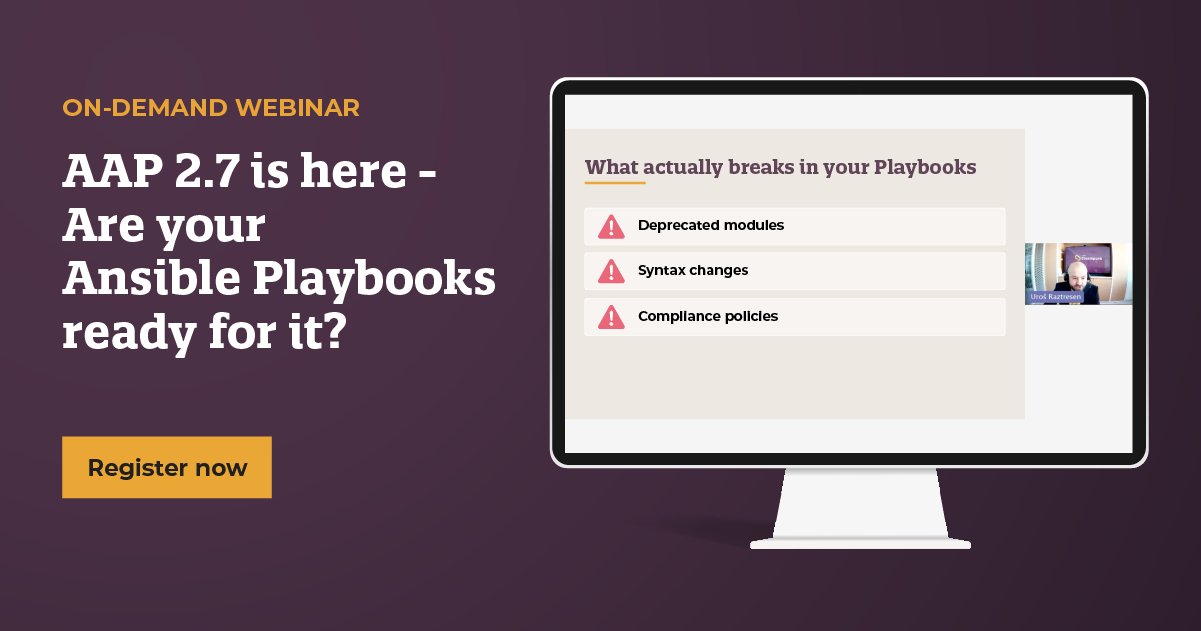
Deprecated modules. Ansible Core removes deprecated modules across major versions. A Playbook that ran cleanly on Ansible 2.9 can fail silently on 2.16 because the module it calls no longer exists. Some failures only surface under specific runtime conditions — which means they can get through testing and land in production.
Changed syntax and FQCN requirements. Playbooks using short module names instead of fully qualified collection names often pass ansible-lint without complaint. Some fail execution anyway – most commonly when modules are ported out of ansible-core into separate collections. It’s a failure mode that quietly erodes upgrade confidence: the tooling says it’s fine, the runtime doesn’t always agree.
Compliance policies — now enforced. AAP 2.7 ships tightened execution environment controls and stronger defaults around privilege escalation. Playbooks that relied on implicit privilege grants or accumulated technical debt hit enforcement walls on the new platform. These aren’t bugs. They’re issues that were always there; the upgrade just made them impossible to defer.
What to do before the upgrade window opens
The answer isn’t a manual audit. At enterprise scale — thousands of Playbooks, multiple repositories, years of accumulated automation — manual review is measured in engineer-months and still misses things.
Steampunk Spotter scans your Ansible Playbooks against the target Ansible Core version, identifies deprecated modules, flags syntax violations and FQCN gaps, surfaces compliance policy conflicts, and auto-fixes what it can handle. Every rewrite comes with a full diff and risk categorization. What’s left after auto-fix is a short list of issues that actually need human judgment — not a line-by-line search for deprecated module calls.
A U.S. bank with 2,300 Playbooks across 200 repositories used this approach for an AWX-to-AAP 2.5 migration. 57,000+ tasks auto-rewritten. 7,600+ engineering hours saved. Full traceability on every change.
The difference between a three-month migration and a multi-year remediation effort is knowing what you’re walking into.
For the full upgrade methodology step by step, see our complete guide to Ansible upgrade and migration.
Are your playbooks ready for AAP 2.7?
We covered exactly this in our on-demand webinar — what AAP 2.7 does to your existing Playbook estate, a live Spotter scan, and three enterprise case studies from teams who’ve done this at scale.
Ready to look at your own environment? Book a strategic planning call with our automation experts: we’ll evaluate your current state, define your goal and timeline, and put together a concrete plan to get your Playbooks AAP 2.7-ready.
Book your strategic planning call.